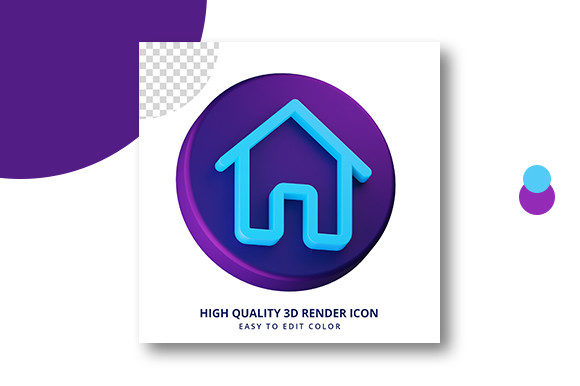
Home Icon in 3d Rendering Premium
In the rapidly evolving landscape of digital design, visual hierarchy and user interface (UI) clarity are paramount. Designers frequently seek assets that not only convey meaning instantly but also integrate seamlessly into modern web and application ecosystems. Among these essential elements is the Home Icon in 3d Rendering Premium, a versatile graphic asset designed to enhance navigation structures across various digital platforms. This article provides an objective evaluation of this specific icon style, exploring its technical specifications, potential use cases, and the trade-offs involved in adopting three-dimensional rendering for UI components.
Understanding the Asset: What Is It?
The term "Home Icon in 3d Rendering Premium" refers to a high-fidelity graphical representation of a house or residence, created using advanced 3D modeling techniques. Unlike traditional flat vector icons, which rely on two-dimensional shapes and solid colors, this asset utilizes depth, lighting, shadows, and texture to create a realistic or stylized three-dimensional appearance. The "Premium" designation typically implies higher resolution files, refined geometric details, and professional-grade aesthetics suitable for commercial projects.
These icons are often distributed as part of comprehensive UI kits, allowing designers to access multiple variations of the same symbol. The core value proposition lies in its ability to serve as a primary navigation element while adding a layer of visual sophistication that flat design sometimes lacks. For users researching design assets, it is crucial to distinguish between simple illustrative graphics and functional UI components. This particular icon bridges that gap by offering aesthetic appeal without sacrificing immediate recognizability.
Key Features and Technical Flexibility
One of the most significant advantages of modern 3D UI assets is their adaptability. The Home Icon in 3d Rendering Premium is engineered to be easily editable, ensuring that it can align with diverse brand identities. Key features include:
- Color Scale Adjustment: Users can modify the color palette to match specific website themes or marketing campaigns. This flexibility allows for consistent branding across different touchpoints.
- Scalability: While 3D renders can sometimes suffer from pixelation when scaled down, premium versions are optimized for various resolutions. They can be resized for use in small navigation bars or large landing page headers without losing critical detail.
- Format Versatility: These assets are typically available in formats compatible with major design software such as Figma, Sketch, Adobe XD, and Photoshop. Some may also come in WebGL-ready formats for interactive web experiences.
This level of control empowers designers to tweak lighting angles, material finishes, and chromatic values, ensuring the icon does not feel like a generic stock image but rather a bespoke component of the user interface.
Applications and Use Cases
The versatility of the Home Icon in 3d Rendering Premium makes it suitable for a wide array of digital contexts. Understanding where this asset fits best helps designers make informed decisions about its implementation.
Website and Landing Page Design
On landing pages, first impressions are critical. A 3D home icon can serve as a focal point in hero sections, particularly for real estate platforms, property management services, or smart home technology companies. Its depth draws the eye and adds a sense of tangibility to virtual spaces, enhancing user engagement.
User Interface (UI) Kits
For mobile applications and web dashboards, consistency is key. When included in a UI kit, this icon ensures that navigation elements maintain a cohesive visual language. It is particularly effective in apps where the "home" function represents a dashboard or main hub, providing a comforting and familiar anchor for users.
Social Media and Marketing Materials
Beyond functional UI, these icons are valuable for marketing collateral. YouTube channel banners, social media posts, and promotional ads benefit from the visual pop that 3D elements provide. In a crowded social media feed, a rendered icon stands out more effectively than a flat line-art version, potentially increasing click-through rates for promotional content.
Web Banners and Advertising
Digital advertising requires quick comprehension. The Home Icon in 3d Rendering Premium communicates direction and safety instantly. When used in banner ads for e-commerce sites or service providers, it reinforces the idea of returning to a safe, central place, subtly guiding user behavior toward conversion points.
Evaluating Benefits and Tradeoffs
While the aesthetic appeal of 3D icons is undeniable, integrating them into a design system requires careful consideration of performance and usability.
Benefits
The primary benefit is enhanced visual interest. Three-dimensional elements break the monotony of flat interfaces, creating a more immersive experience. Furthermore, they can convey quality and professionalism, suggesting that the underlying product or service is equally well-crafted. The ability to customize colors and scales ensures that the asset remains relevant as design trends shift.
Potential Drawbacks
However, there are tradeoffs to consider. File size is a significant factor. High-quality 3D renders, especially those with complex textures or transparency effects, can increase page load times if not optimized correctly. Slow loading speeds negatively impact user experience and search engine rankings. Additionally, accessibility must be addressed; screen readers cannot interpret visual depth, so proper alt-text and semantic HTML structure remain essential.
Another consideration is cognitive load. While 3D icons can be engaging, overuse can lead to visual clutter. If every element on a page is rendered in 3D, the interface may become overwhelming. The Home Icon in 3d Rendering Premium works best when used strategically to highlight key navigation points rather than as a decorative filler.
When to Choose This Asset Over Alternatives
Deciding whether to use a 3D rendering versus a flat vector icon depends on specific project goals. The Home Icon in 3d Rendering Premium is a strong fit for brands aiming for a modern, tech-forward, or luxurious image. It is ideal for projects where visual differentiation is a priority, such as creative agencies, innovative tech startups, or lifestyle-oriented platforms.
Conversely, alternatives may be worth considering in certain scenarios. For minimalist designs focused on speed and efficiency, flat icons are often preferable due to their smaller file sizes and cleaner aesthetic. Similarly, for highly accessible applications targeting diverse user groups, including those with visual impairments, simpler, high-contrast flat icons may provide better usability. If the project demands rapid iteration across multiple devices with strict bandwidth limitations, lightweight SVG flat icons might be a more practical choice.
Practical Decision-Making Insights
To determine if this asset aligns with your needs, evaluate the following criteria:
- Brand Identity: Does your brand voice support a playful, detailed, or premium aesthetic? If yes, 3D elements are likely appropriate.
- Performance Requirements: Can your development team optimize 3D assets for fast loading? If performance is the top priority, test the asset’s impact on site speed before full integration.
- Design Consistency: Will this icon clash with other interface elements? Ensure that the lighting and style of the Home Icon in 3d Rendering Premium harmonize with the rest of the UI kit.
- Target Audience: Consider your users' expectations. Tech-savvy audiences may appreciate the innovation of 3D, while older demographics might prefer the clarity of traditional flat designs.
In conclusion, the Home Icon in 3d Rendering Premium offers a powerful tool for designers seeking to elevate their digital interfaces. By balancing aesthetic richness with functional flexibility, it serves as a valuable component for websites, apps, and marketing materials. However, successful implementation requires a thoughtful approach that weighs visual impact against technical constraints and user experience goals. When used judiciously, this asset can significantly enhance the perceived quality and navigational clarity of a digital product.